Anxiety for Beginners by Eleanor Morgan
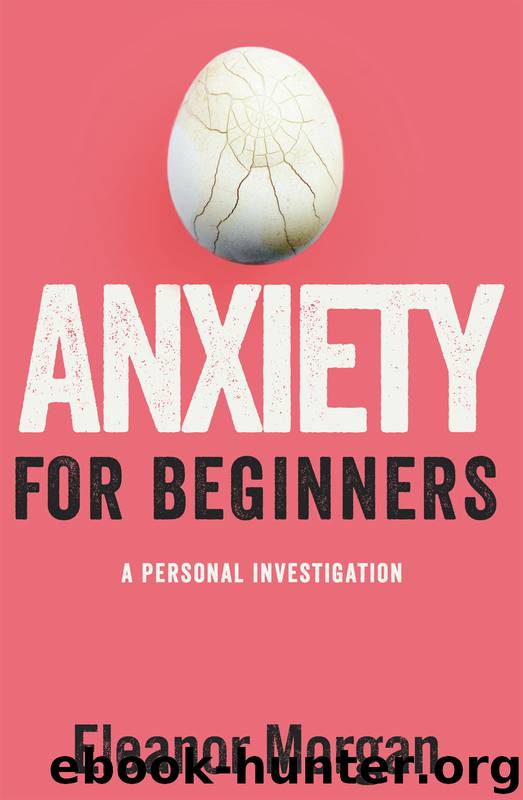
Author:Eleanor Morgan [Morgan, Eleanor]
Language: eng
Format: epub
ISBN: 9781509813254
Publisher: Pan Macmillan UK
BLUE CURTAINS
‘Love, two centimetres from grief,’ is how my friend Eva described the feeling she had for her new baby after she was born. Eva (Wiseman) is a columnist for the Observer and wrote about birth and babies (even though she had thought she wouldn’t) because, as she said, how could she not? It was everything.
‘Because they tell you: “All that matters is that your baby is healthy”, but without wanting to make you feel bad, baby, asleep here next to me with your snore like a faraway A-road, that’s bullshit,’ she wrote. ‘That phrase is one that works to embarrass and silence us. It doesn’t mean to, but it does. So five months on it’s considered pretty gauche to still be talking about the birth.’
I saw Eva a lot in those months, the baby a most perfect seashell, and we talked about it all. The opinions people have that snake through your belly, the loneliness, the guilt of not feeling serene and cocooned, like the adverts tell you you’ll feel, and instead pace-y, lonely and mad – made even scarier because it’s all love.
I could only empathize with the newness and weight of it all. She was my first friend to have a baby (Kate followed shortly) and bearing witness to all that big emotion happening in a small space made me think about how thin the membrane is between coping with that adjustment and splintering.
Perinatal mental health illnesses (‘perinatal’ means the period between getting pregnant and the baby being a year old) are incredibly common, thought to affect at least one in ten women. Sally Hogg’s 2013 NSPCC report ‘Prevention in Mind’ estimated that, in England alone, 284,890 women are affected each year. Over a quarter of a million women. Every year.
These are astonishing numbers, particularly when you consider that nearly half of all women live in places where there’s no perinatal mental health provisions. Of the services that exist elsewhere in the UK, few met national quality standards as of April 2015. Pregnancy and giving birth, it seems, are still so often seen as a physical passage for the mother, rather than physical and psychological. But when perinatal mental health problems can range from anxiety and panic attacks to depression, PTSD and even postpartum psychosis, it makes those statistics – over a quarter of a million people in England alone – scream.
Figures released in December 2015 by the Royal College of Midwives (RCM) suggested that it’s more like twenty per cent of all women who experience perinatal mental illness. For many of these women, the main problem is anxiety. The National Institute for Health and Care Excellence (NICE) has said that thirteen per cent of women experience anxiety during pregnancy, and around twelve per cent experience depression – with many affected by both.
Yet perinatal anxiety is little discussed and too rarely recognized. The RCM estimates that only around half of cases are identified. ‘We have designed our programmes to tackle anxiety early on because it’s such a
Download
This site does not store any files on its server. We only index and link to content provided by other sites. Please contact the content providers to delete copyright contents if any and email us, we'll remove relevant links or contents immediately.
Waking Up in Heaven: A True Story of Brokenness, Heaven, and Life Again by McVea Crystal & Tresniowski Alex(37925)
Still Foolin’ ’Em by Billy Crystal(36468)
Cecilia; Or, Memoirs of an Heiress — Volume 1 by Fanny Burney(32720)
Cecilia; Or, Memoirs of an Heiress — Volume 2 by Fanny Burney(32088)
Cecilia; Or, Memoirs of an Heiress — Volume 3 by Fanny Burney(32065)
Fanny Burney by Claire Harman(26722)
Empire of the Sikhs by Patwant Singh(23203)
We're Going to Need More Wine by Gabrielle Union(19168)
Hans Sturm: A Soldier's Odyssey on the Eastern Front by Gordon Williamson(18724)
Plagued by Fire by Paul Hendrickson(17537)
Out of India by Michael Foss(17022)
All the Missing Girls by Megan Miranda(16697)
Cat's cradle by Kurt Vonnegut(15555)
For the Love of Europe by Rick Steves(14907)
Pimp by Iceberg Slim(14793)
Molly's Game by Molly Bloom(14258)
Bombshells: Glamour Girls of a Lifetime by Sullivan Steve(14217)
Leonardo da Vinci by Walter Isaacson(13508)
4 3 2 1: A Novel by Paul Auster(12611)
